Related Articles


 Related Articles


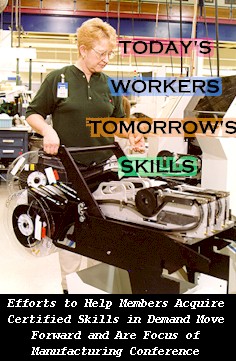
Today's Workers - Tommorrow's SkillsSeptember 1998 IBEW Journal
Is the pattern clear? "As we focus on what we can do to make a difference in the lives of our members, we come back to one thing — skills," International President J.J. Barry told the delegates to the 1998 Manufacturing Conference. The conference’s theme was "Making a Difference." As discussed at the meeting, the biggest difference between the past and the future in manufacturing is the growing demand and opportunity for workers who possess certified levels of skills, while those who do not will face prospects that are far more bleak. The IBEW has been involved in various ways to help its members in the industrial branches develop the skills needed to compete for the best jobs of the future. Negotiation of training and educational programs is one very important tactic. As public policy has increasingly dovetailed with the IBEW’s philosophy, the union has been active in helping to write the standards by which workers of the future will be judged. As reported in the IBEW Journal last year (see "Skills to Power a Nation," April 1997, p.22), the National Skill Standards Board (NSSB) was created in 1994 with the mission, "...to serve as a catalyst in stimulating the development and adoption of a voluntary national [U.S.] system of skill standards and assessment and certification of attainment of skill standards." The NSSB consists of 27 members from labor (including the IBEW), business, the educational community, and the U.S. Departments of Labor, Education, and Commerce, and other groups.
While the NSSB is developing general standards that will apply to all occupational clusters to measure proficiency in levels ranging from core to specialty skills, specific standards are being developed for each of the 16 occupational categories. The first of these is manufacturing, and the IBEW has been involved in this process on both levels. Ken Edwards, director of the IBEW Research and Technical Services Department is a member of the NSSB. Bob Stander, director of the IBEW Manufacturing Department, serves on the Manufacturing Skill Standards Council (MSSC). The Council includes representatives of unions and professional associations, employers and public interest organizations. The first task of the MSSC was to commission a strategic plan to identify the specific need for skill standards in this sector and lay out the best means to develop them. Taking into account the projected needs of industry in North America, the plan determined that standards are needed as a tool to increase work force skills, facilitate skills portability and career improvement, and foster the creation of high performance workplaces offering high-wage jobs. The MSSC envisions that over the next ten years, skill standards will be voluntarily embraced and implemented in industry. A copy of the strategic plan was distributed to the delegates to the IBEW Manufacturing Conference. The plan is now in the process of being implemented under a grant from the U.S. government. Offering a labor perspective on the move toward skill standards at the conference were Robert Baugh, AFL-CIO Human Resource Development Institute (HRDI) and Ellen Scully, the Work and Technology Institute. They noted that the call for a new work force development system is based on the belief that the labor market as currently structured will not lead to the spread of high performance, high-wage work systems. Baugh and Scully presented labor’s stake in the development of such system in plain terms: Labor can let employers develop skill standards based on narrow needs of production, or can get involved to ensure the development of systems that also benefit individual workers and help build strong unions. Their presentation sparked a lively discussion of the issue and how IBEW local unions can best deal with this emerging trend. The workplaces of the 21st century will look different than those of today. For the workers who toil in them, brains, not brawn, will be the passport to the future. The IBEW Journal will feature more articles on this very important issue in the future, so that IBEW members can remain informed of trends that will have a definite impact on their working lives. A Spirited Manufacturing Conference Faces the Future
President Barry picked up on the theme in his address, discussing the many ways in which the IBEW makes a difference in the lives of its members — through organizing, collective bargaining and providing a collective voice in the legislative and political arenas. He re-emphasized the importance of skill standards and labor’s involvement in their development. "At a time when the need for skilled workers is greater than ever... at a time when labor has more leverage than anytime in the past two decades," he stressed, "we must seize the moment to move forward." Secretary-Treasurer Edwin D. Hill provided a perspective on the organizing challenges facing the IBEW and emphasized the importance of political action in the United States and Canada. The delegates responded by contributing in excess of $5,000 to IBEW-COPE at the conference. The theme of political action was also the focus of a stirring address by Lena Guerrero, a political activist and former elected official in Texas. She urged delegates to help their members find their true voice in the democratic process not only through organizing new units, but by mobilizing and educating current members on the issues of the day. As always, organizing was a major topic at the conference, and IBEW Special Projects Director Gary Heald conducted an afternoon session devoted to the topic. The delegates were seated at round tables in a way that assured that representatives of different locals from different districts were intermingled. Director Heald posed several questions to the group, inquiring about good experiences locals have had with organizing, bad experiences, reasons why locals have not organized in the past, what locals need from the International to facilitate organizing, and what concrete benefits organizing can bring to existing locals and members. Delegates engaged in frank discussion on these and other issues, especially on the need to organize nonunion plants in the same company or sector of the industry. Another major issue in manufacturing today is the contracting of work to outside vendors or "outsourcing" and the outright closing of plants. Manufacturing Department Representatives Mike Quinlan, Mary O’Brien, Peter Potenza and Bob Roberts conducted an open dialogue on these issue, which cut to the very heart of the decline in jobs in North American manufacturing. Representative Quinlan asserted that the process of keeping a plant open begins long before a company serves notice of a closure. Locals have the right and the obligation to challenge employers on the manner in which they run plants because in today’s economy inefficient operations usually will be shut down. The staff and delegates discussed how locals must constantly be aware of changes in plant operations to pick up on signs that work may be contracted or moved to offshore locations. Director Stander applauded the delegates for embodying the enthusiasm and fighting spirit of the IBEW’s Manufacturing Branch, which remains strong despite the industry restructuring and job losses of the past two decades. Attendance at this year’s conference was one of the five highest in 16 years, despite the fact that there are fewer members working in fewer units than before. Perhaps the spirit of the conference can be summed up in the story of one delegate from a small local in Kentucky. Although the local could not afford to pay his way, the delegate came at his own expense because he felt that these conferences provide vital information and because sharing experiences with brother and sister locals was very valuable. When the other delegates heard of this, they passed the hat and together contributed enough money to cover the delegate’s meeting expenses. The spirit of the Brotherhood is alive and well.
|