Related Articles


 Related Articles


Telecommunications: A Break in the TurmoilSeptember 1998 IBEW Journal
The breakup of AT&T in 1981 started a chain reaction in the telecommunications that has consisted of unimaginable technological advances, massive industry restructuring, thousands of lost jobs, and constant turmoil as a way of life. The passage of the 1996 Telecommunications Reform Act promised to speed up the pace of change. For IBEW members employed in the telecommunications industry, there is hope for a respite from the rapid change. Contracts negotiated with three major employers of IBEW members in the telecommunications branch (one covering many members in manufacturing as well) promise a measure of stability for the next five years along with the prospect of increasing our membership in these companies. In a year of heavy industry bargaining, IBEW members at AT&T, Lucent Technologies and Ameritech recently ratified their respective contracts.
The IBEW and Communications Workers of America (CWA) have entered into a new working partnership with the GTE Corporation, raising hopes for a new era of enlightened labor-management relations at a company where friction between workers and management has been common. The Telecommunications Conference brought into focus the state of the telecommunications industry nationally and globally. AT & T The new agreement between the IBEW, the CWA and AT&T, represents the earliest contract settlement, nearly three weeks before the expiration of the current contract, and the longest new contract term ever negotiated. An important feature of the four-year contract provides for immediate consent elections overseen by an impartial umpire for unorganized units at AT&T Wireless, Solutions and all future acquisitions including Teleport and TCI, should the highly publicized merger go through. If the umpire should determine that AT&T management has failed to live up to its neutrality pledge, then future recognition will be based solely on majority card-check, with no elections required.
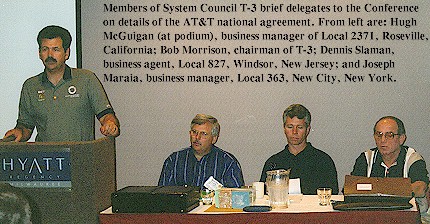
Bob Morrison, chair of the IBEW’s system council at AT&T, who served on the negotiating committee, added, "Maintaining a high quality work force is critical in the modern telecommunications industry. We are pleased that AT&T recognizes that its bargaining unit workers are essential to the future success of the company." A new AT&T Performance Plan, replacing Shares for Growth, gives members the same profit-sharing plan that management now enjoys, but with a guaranteed minimum payment of $400 each year, which managers don’t get. The plan also pays $850 if all performance goals are met and even more if goals are exceeded. Other highlights include improvements in health care coverage, including lower generic drug co-payments. Next year, health care and some other benefit coverage will also be extended to designated same-gender partners. Medicare HMOs for certain retirees will be used as a way to control costs. Revised health care caps for retirees now include dental coverage. Many existing programs will be continued and expanded, such as the Family Resource Program, which provides help in finding child and elder care, adoption services and education resources. The new contract adds stress management resources to this program. AT&T will also continue its scholarship program for children of union employees. A ratification vote produced 90 percent approval among IBEW members covered. Members of System Council T-3 brief delegates to the Telecommunications Conference on details of the AT&T national agreement. From left are: Hugh McGuigan (at podium), Business Manager of Local 2371, Roseville, California; Bob Morrisson, Chairman of T-3; Dennis Slaman, Business Agent, Local 827, Windsor, New Jersey; and Joseph Maraia, Business Manager, Local 363, New City, New York. Ameritech
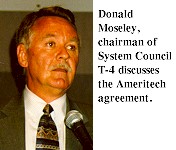
Highlights of the agreement include an immediate first-year base-wage increase of 3.5 percent, 3.7 percent in the second year and 3.6 percent in the third year. In addition, when the agreement was ratified, each employee received a $500 bonus. The package also includes pension increases of 12 to 18 percent, depending on age, for future retirees and a continuation of the existing "30 and out" as well as lump sum provisions. Also, Ameritech agreed to an increase in company matches to all IBEW members’ savings plan contributions from 60 cents on the dollar to 80 cents on the dollar. In the fourth and fifth years of the contract, wages, pensions and several other wage-related items, will be reopened and negotiated with all other terms of the agreement remaining in force during that same time period. No health care premium payments will be required for active employees or for those who may retire during the full term of the five-year contract. Ameritech also agreed to card-check recognition in the company’s cellular unit, as well as an employer neutrality agreement, for all IBEW union organizing efforts at the company. A growing number of IBEW contracts are carrying provisions for card-check recognition for organizing in their contracts. "This is an extremely important agreement for IBEW members," said Donald L. Moseley, System Council T-4 Chairman. "This new five-year agreement, the first in the history of the T-4 Council, addresses the job security concerns that all working families face today." Members of the T-4 locals voted for the new contract by a four to one margin. Seventeen contracts have been negotiated with Ameritech since 1947. Workers have struck only twice in that period: in 1968 and 1983. A strike was narrowly averted in 1995, when Ameritech attempted to take away many of the gains earned by workers in previous collective bargaining agreements. Lucent After last minute negotiating sessions and a brief strike call, the IBEW, Communications Workers of America (CWA) and Lucent Technologies reached tentative agreement at 2:15 a.m. on June 1, 1998 on a national contract covering 44, 000 company employees represented by the two unions. "We believe that the agreement is a good one for the workers who have helped make Lucent a success since its spin off from AT&T in 1996," said Frank Possinger, President of the IBEW’s System Council EM-3 representing approximately 17,000 members employed at eleven Lucent manufacturing facilities. "Our goal was to make sure that our members received their fair share of that success, including increased job security." Bob Morrison, chairman of the IBEW’s council representing some 2,000 operations workers at Lucent added, "Negotiations were very difficult at times, but we feel that this contract protects active and retired workers and will keep the company moving forward to serve our customers in the competitive world of modern telecommunications." The contract features wage increases totaling 18.75 percent, with compounding over the five-year life of the agreement and additional increases if inflation increases significantly during the later years of the contract, plus increases in the pension band totaling 20 percent over the life of the contract. Lucent will contribute $1,000 in company stock to employees participating in the savings and security plan upon ratification of the contract. Two additional contributions totaling $1,000 will be made in 1999. The agreement also provides for participation in a pay-for-performance program that gives employees $1,000 in 1999 and more in later years, if Lucent meets performance objectives. Lucent also agreed to place limits on the company’s ability to subcontract work performed by bargaining unit members. The new contract, which runs through May 31, 2003 also continues certain principles concerning union organizing, access to employees and the code of conduct to be followed during organizing efforts. The national agreement won ratification among members of both EM-3 and T-3 at Lucent by a combined margin of 67-33 percent, as announced on June 24, 1998. Bargaining was contentious, however, on local agreements covering specific facilities. Brief strikes occurred at the Lucent plants in Orlando, Florida, and Columbus, Ohio, but settlements were eventually reached in all locations. Bell Atlantic The IBEW’s more than 13,000 members in New England put their negotiations on hold until Bell Atlantic came to terms with the Communications Workers of America (CWA) during that union’s recent strike against the company. IBEW Local 2213, Washington Mills, New York, held a strike against Bell Atlantic from August 9 at 12:01 a.m. until August 11 at 11:50 a.m., when the union and company reached a tentative agreement. Details of the strike and the IBEW/Bell Atlantic agreements were unavailable at press time. IBEW, CWA and GTE
By using a more cooperative approach, the partners will put to rest much of the dissension that has haunted their labor relations in the past. The new partnership is based on a concept called "conflictive partnership," defined by John Calhoun Wells, former director of the Federal Mediation and Conciliation Service. It acknowledges that while the company and unions have different perspectives on many matters, they look for common ground to work together for the benefit of everyone. The partnership recognizes the vital impact employees have on marketplace success and encourages company-union collaboration to find solutions to key issues. Its goals are to enhance the success and image of the company, to acknowledge unionized workers as valued partners and to foster pride and commitment among all employees. A policy committee composed of key senior IBEW, CWA and GTE leadership will oversee the partnership. "The IBEW truly believes there are no limits to where this partnership can take our organizations," said International President J. J. Barry. "We look forward to working together with full equality, open communication, mutual respect and flexibility. If carried out in the right spirit, this partnership will unlock the true potential of the work force." One of the partnership’s guiding principles is to create and sustain an envied workforce with a passion to satisfy customers and a commitment to continuous improvement. (Ed. Note — As of this writing, it was unclear when effect, if any, the proposed GTE/Bell Atlantic merger would have on the partnership.) Telecommunications Conference
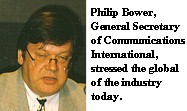
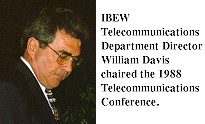
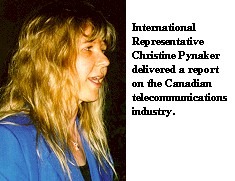
Director Davis then introduced Philip Bowyer, General Secretary of Communications International, Geneva Switzerland. Mr. Bowyer emphasized that telecommunications companies are becoming increasingly global in their business scope. Enormous changes are taking place in this industry: in information services, postal banking and finances services, electricity generating industry and radio and TV broadcasting and cable services. Worldwide issues such as privatization, deregulation, the rise of multinationals, technology and convergence have had a major impact on union members, the jobs they perform and the sectors in which they work. Communications International, a global labor organization four million members strong, recognizes these developments and challenges and contends that national unions should join together to address worldwide labor issues and act with solidarity on those issues. Other activities at the conference included an Industry Profile and Internet Basics by International Representative Jim Brimer, a Canadian Report by International Representative Christine Pynaker and an Organizing Workshop by Gary Heald, Director of the IBEW Special Projects Department.
|