1998 IBEW CONSTRUCTION CONFERENCE
"Imagine The Future"
June 1998 IBEW Journal
IBEW Looks to Technology, Training and Organizing as Keys to the Future of the Construction Industry
In market after market throughout the United States and Canada, the news from IBEW construction locals is the same: work is good. The performance of the economy has generated a great deal of construction that is keeping the hiring halls busy in many parts of the continent.
As delegates to the 1998 IBEW Construction and Maintenance Conference (see highlights below) gathered in Washington, D.C., in late April, a common question was: What now?
The IBEW’s answer is found in the theme of this year’s conference — Imagine the Future. The future of the IBEW members in the Construction Branch can be good if the proper planning is done now. The strategy for the future includes several major elements: 1) keep organizing the nonunion sector of the electrical construction industry in a strategic fashion; 2) continue to identify new technology that will create the jobs of the future and develop the training programs needed to get that work for IBEW members, and 3) prepare for the inevitable ups and downs in the industry and help those brothers and sisters who do not share in the good times. This article explores some of those concepts and their impact on IBEW members.
Solar Photovoltaics — A ‘Hot’ Technology
 The IBEW believes that the field of solar photovoltaic energy, already one in which members have worked, will be the source of job growth in the future. Solar photovoltaic energy is not new, but is growing tremendously. It is a renewable technology which converts sunlight through photovoltaic cells directly into electricity. Photovoltaic installations not only energize the electrical industry, but also provide employment for qualified, certified union construction electricians across America. The IBEW believes that the field of solar photovoltaic energy, already one in which members have worked, will be the source of job growth in the future. Solar photovoltaic energy is not new, but is growing tremendously. It is a renewable technology which converts sunlight through photovoltaic cells directly into electricity. Photovoltaic installations not only energize the electrical industry, but also provide employment for qualified, certified union construction electricians across America.
The industry has embraced this technology as the premium way of harnessing the sun’s power, utilizing only one percent of available sun energy to provide enough power for all of mankind’s early 21st century needs.
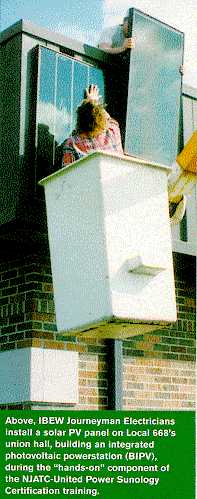
 The National Joint Apprenticeship and Training Committee (NJATC), the training arm of the unionized electrical construction industry, has worked in partnership with United Power Ltd., a Canadian company, to supply and distribute training material to local training programs. The program’s course content includes training to learn about sun energy; photovoltaic (PV) effect, PV modules, arrays, systems, concentrating and reflecting systems, batteries, chargers, power conditioning equipment; PV applications of existing solar PV systems, methodology, hybrid systems, PV systems; grid-connected PV systems, sizing and design; PV and the Electrical Code; studies of existing installations; and much more. The solar voltaic revolution has waved goodbye to old methods of electrical distribution and construction. The National Joint Apprenticeship and Training Committee (NJATC), the training arm of the unionized electrical construction industry, has worked in partnership with United Power Ltd., a Canadian company, to supply and distribute training material to local training programs. The program’s course content includes training to learn about sun energy; photovoltaic (PV) effect, PV modules, arrays, systems, concentrating and reflecting systems, batteries, chargers, power conditioning equipment; PV applications of existing solar PV systems, methodology, hybrid systems, PV systems; grid-connected PV systems, sizing and design; PV and the Electrical Code; studies of existing installations; and much more. The solar voltaic revolution has waved goodbye to old methods of electrical distribution and construction.
Complete NJATC Sunology Orientation Certification programs have taken place at IBEW Local 213, Vancouver, and Local 993, Kamloops in British Columbia.; Local 340, Sacramento, California; and Local 668, Lafayette, Indiana, with great success. The IBEW union halls have initiated the "hands-on" portion of the NJATC Sunology Orientation Certification. At Local 213, Business Manager Charlie Peck has ordered a 2.0 kW BIPV Power Station for installation on the south and east facades of the union hall. Business Manager Ray Simpson, Local 668, has ordered a 3.6 kW BIPV Power Station for installation on the west and south facades of the union hall. These systems will be grid connected systems, installed by NJATC Sunology Orientation graduate IBEW electricians from each respective local, as the "hands-on" training component.
Strategic Organizing
The Construction Organizing Program of the IBEW has entered a new phase, one in which greater coordination, communication and strategic targeting play a central role.
Under the new process, Vice Presidents from each IBEW District select a committee to discuss issues, strengths, weaknesses, threats, portability and uniform testing and develop a strategic plan, which is presented to business managers, organizers, officers and rank and file members (20-25 people). They determine what the goals are; what they want to accomplish and what they plan to do now, not a year from now. The group establishes 8-15 goals and comes up with action plans to be implemented. This information is entered in a computer program, allowing access to locals around the country. This method not only provides an avenue to share strategies, but also provides ideas and solutions that other locals may have experienced and what they did to solve it. This computer program highlights cases of Unfair Labor Practices (UPLs) and decisions made by the National Labor Relations Board.
The IBEW has set a goal of organizing goal of 15 percent of unrepresented workers in each jurisdiction. New inroads are being made to involve employers in union organizing efforts. Some locals are developing standard procedures to evaluate, test and admit members into the IBEW. Others have identified at least five nonunion contractors that they will approach with their plan.
Third District Construction Organizing Coordinator, Gene Adams, described the plan in his district, saying that workers were taught to write their own affidavits, file their own ULP reports and process necessary paperwork for any situation. "We have had real good success in organizing workers and nonunion contractors and have increased our membership substantially, "said Adams. "We have had full-time organizers for over five years, 52 of them, who meet every four months. In between, I meet with those locals which have been training in COMET I and II. We realize that we have to organize nonunion workers--a challenging task, due to the massive attack by the right wing, spewing incorrect information."
Sixth District Construction Organizing Coordinator Jeff Lohman talked about his District’s goals, citing 11 different goals at various stages. Some are currently forming committees to work on organization, and some individual local unions work on different new member orientation programs. A new-member survey was given to determine the attitudes and the things members feel were good about coming into the IBEW. A committee was formed to look at the way tests are evaluated. Said Lohman, "Each of our states has a full-time organizer. We have a District-wide goal of 60 percent of active construction members, who will be given an opportunity to go into COMET training before the end of the year. We have set a goal to organize 15 percent of the unorganized work force. Another point--we developed a better communication system, through a newsletter, based on [the percentages] that the local union and the International have developed."
Supplemental Unemployment Benefit Funds
Realizing the cyclical nature of the construction industry, the IBEW and the National Electrical Contractors Association jointly developed a model plan to provide supplemental unemployment benefits to members in areas where work is slow. These plans would provide extra benefits to members in addition to those received from their respective local governments. Implementation of these plans is the decision of the local union and the local contractors and must be negotiated at that level.
The Supplemental Unemployment Benefit (SUB) Fund would generally provide income protection benefits in addition to state unemployment compensation when members are unemployed due to lack of work in the electrical industry. A benefit trust would be established to provide these benefits and contributions to the trust would be negotiated. Members who have contributions remitted on their behalf and meet minimum participation requirements would be eligible for benefits as early as the second calendar year of service. Eligibility to receive SUB fund benefits would generally be tied to eligibility for state benefits. However, members with sufficient eligibility credits could receive benefits after cessation of state unemployment compensation, as long as they remain unemployed and available for work in the jurisdiction of their local union.
A review of existing SUB plans has found that locals with a combined total of approximately 34,800 members currently have negotiated some type of supplemental unemployment benefit. Local 292, Minneapolis, Minnesota, Business Manager Jerry Westerholm negotiated such a plan for his members, as have Local 1, St. Louis, Missouri, and Local 212, Cincinnati, Ohio. Local 292's plan allows payments to be made when a worker is unemployed, which in no way jeopardizes a member’s weekly unemployment benefits; provides a generous interest accrual on the account; and places fully funded accounts into an annuity fund, yielding a higher rate of interest. These funds can also be used for death benefits, retiree health care and academic scholarships and all contributions are tax deferred.
As President Barry noted in his keynote address at the Construction and Maintenance Conference, now is the time for the IBEW and its organized electrical contractors to plan the future of the industry from a position of strength. Training, organizing and improved benefits to members will help make that vision come to life in the 21st century.
1998 IBEW Construction and Maintenance Conference Highlights
The 1998 IBEW Construction and Maintenance Conference opened its General Session at the Hyatt Regency on Capitol Hill, on April 17-18, 1998, in Washington, D.C. After the colorful opening ceremony, with the combined U.S. Military Color Guard and the renowned IBEW Local 3, New York, Pipe & Drum Band, The Sword of Light, International President J.J. Barry and International Secretary-Treasurer Edwin Hill addressed the delegates. Both officers focused on organizing, training, investments and technology, but especially emphasized the antiunion virus in the form of a dues initiative, which requires each union member to give written permission to the union to use a portion of their dues for political purposes.
Senator Edward Kennedy (D-MA) delivered a poignant address. He told of his battle in the Senate with anti-worker GOP strategists, who are diligent in the way they craft their message, but underlying that message is the truth: it is antiunion legislation. He reminded us that he is an ally labor can count on, but cautioned that we must be vigilant, focused and remain ready for the challenges ahead.
Other notable speakers were: IBEW General Counsel Lawrence Cohen; George Ingham, United Power; John C. Wells, Federal Mediation and Conciliation Service (FMCS); George Miller, National Fire Prevention Association (NFPA); Sara M. Fox, National Labor Relations Board (NLRB); A.J. Pearson, NJATC; Mary Tahan, Tahan Advertising; James Pauley, Square D Company; Sue Bookman & Bill Rivers, The Segal Company; and IBEW Local 48 Business Manager-Financial Secretary, Gerald Bruce.
Two-day workshops were held on Innovations, Organizing, Investments and the NJATC, at which delegates shared interests, solutions and ideas.

|
|
 Related Articles