


United Nations Broadcasting Members
|
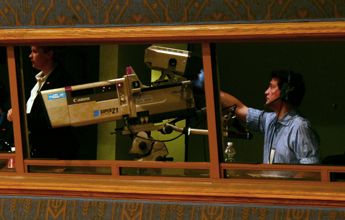 |
| Mike Messina, a member of New York Local 1212, prepares for a shoot at the U.N. Security Council |
James, a Local 1212 assistant business manager, is proud that—over the years—she and others have been able to provide technical hook-ups for nations and diplomats, including some that were waging anti-colonial struggles, but lacked the resources to broadcast on their own.
The U.N.’s first specialized agency, the Geneva-based International Labor Organization, enshrines workers’ rights to secure employment. But back in New York, James and her 66 co-workers are engaged in a sort of rights-based struggle of their own.
They are caught between a contractor and the U.N., both pressuring for staff reductions that would pit union members against each other and inject insecurity into the lives of workers on the cusp of retirement. Says James:
The U.N. seems to be importing big corporation-style hardball into an organization that promotes world peace.
Local 1212 members at the U.N. have always worked for contractors over the 65-year history of their bargaining unit. Most were signatory electrical contractors with New York Local 3 and Local 1212.
When a recent contractor, a broadcasting company, went out of business, Local 1212’s crew worked for a month without being paid. The local union then worked with the U.N. to secure a deal with a new contractor, Priority Production Services Inc. Their deal, like their job security, was short-lived.
The members’ cooperation was paid back with major concessionary demands. PPS proposed that 17 bargaining unit positions be placed under the direct auspices of the U.N. The individuals hired in those positions will receive less pay than the individuals they will supervise. In addition to decreased benefits, they would lose collective bargaining rights and protections provided by federal and state labor laws.
Local 1212 Business Manager Ralph Aviglaino is concerned that these 17 job and benefit reductions are just the first step in a plan leading to the U.N.’s absorption of the remaining bargaining unit positions by the end of June 2012.
Supervisors and maintenance engineers will need to reapply for their jobs as U.N. staff employees. They will be forced to compete for their positions with U.N. staff members as well as applicants from the general public. Those who decline to apply for the U.N. positions will automatically be demoted to non-supervisory positions at a significant reduction in compensation.
The scheme could result in a ripple effect as one IBEW engineer will be laid off for each supervisor or maintenance engineer who declines to apply for the new U.N. position.
Many of the workers in the affected positions, who maintain five radio studios, conference rooms, AV and TV services, are in their late 50’s, says Vinny Butler, Local 1212 assistant business manager, who worked at the U.N. for 35 years. The UN imposes mandatory retirement at age 62. Bidders will, thus, have their current retirement benefits frozen, but have no option to continue working. And the union’s pension and medical coverage would face greater pressure as the number of participants in those plans drops.
Gary Roth, an audio engineer in the TV department, came to the U.N. in 1981 from A&R Records where he worked on recordings by artists including Paul McCartney, the Rolling Stones and Frank Sinatra. Roth was looking for greater job security. He quickly rediscovered some of the allure of his former job, recording everything from papal visits, rock concerts and interviews with the world’s heads of state. “Working at the U.N. as a member of Local 1212 has been a real good career,” he says.
“The contractors we used to work for were mom and pop companies that tried to maintain a decent relationship with the union. The U.N. wanted a so-called, real broadcast company. That’s when they really screwed up,” he says. Roth was on the job when the U.N. brought in consultants. He says:
They walked around for two days asking questions. This was one of the biggest jokes of all. The consultants drew up a report saying they need to decimate our presence.
Local 1212 has posed alternatives to the PPS proposals and the U.N. in exchange for protecting its members collective bargaining rights. The U.N. has not replied. Says Butler:
The U.N. exists outside of U.S. law, so we are limited to grievances and arbitration. However, since the U.S. is the largest contributor to the U.N., we are contacting our members of Congress and the State Department looking for intervention on behalf of our proud and skilled group of dedicated workers and union members.
The IBEW’s conflict with the U.N.’s management is linked to other anti-labor actions by the international body. Secretary General Ban Ki-moon’s administration recently declined to continue dues check-off for the U.N.’s staff union and unilaterally imposed less frequent pay periods. The staff union has collected hundreds of signatures on petitions protesting the pay changes.
Referencing the recent anti-union machinations of Wisconsin Gov. Scott Walker, New York’s Inner City Press wrote:
One labor observer mused that Ban Ki-moon is creating a little Wisconsin on the banks of the East River.
Matthew Lee, an Inner City blogger, questioned an International Labor Organization representative at a conference about the situation facing IBEW Local 1212 members. He was told that the conference was focused on labor rights in Third World countries, not the situation on the East River.


