Union Membership Makes Sharp Upturn in 2008
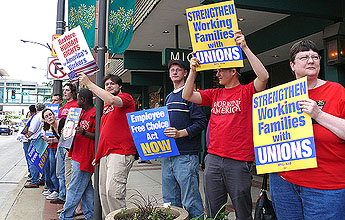 Despite a declining economy and rising unemployment, numbers from the Bureau of Labor Statistics show that union membership rose by largest amount in a quarter-century in 2008. The percentage of American workers in a union rose to nearly 12.5 percent, a gain of more 420,000 workers. Despite a declining economy and rising unemployment, numbers from the Bureau of Labor Statistics show that union membership rose by largest amount in a quarter-century in 2008. The percentage of American workers in a union rose to nearly 12.5 percent, a gain of more 420,000 workers.
While much of the growth has taken place in the public sector where employers are generally less hostile to unions, even the private sector witnessed an increase in membership, growing by more than 150,000.
Until last year, union membership has either declined or stagnated annually since 1983 when membership was at over 20 percent. The latest numbers show that last year’s small uptick in membership wasn’t just a statistical fluke.
“The numbers show that even faced with hostile employers and unfavorable labor law, working Americans want to join a union,” said IBEW International President Edwin D. Hill. “And with the worsening economy, the security and benefits a union brings look even more attractive.”
2008 was also a good year for the IBEW, with aggressive organizing in both the construction and in professional and industrial sectors adding more than 5,000 new members to the rolls, reversing a 30-year slide in membership. (see “Despite Dismal Economic News, IBEW Growth Outpaces Expected Gains,” the Electrical Worker, November 2008.)
“The fact that we’ve continued to attract new members, even under exceedingly tough financial circumstances, shows that the there is a huge hunger out there on the part of the American worker for the things a union can offer – security, better wages, fairness on the job,” said Special Assistant for Membership Development Buddy Satterfield.
While labor market experts are divided on the exact causes of the increase, Economic Policy Institute President Lawrence Mishel says that it can’t be chalked up to job growth in government employment. “The overall increase reflects higher rates of union density in particular sectors,” he explained in a report on the EPI Web site. “(but it) was not driven by higher growth in sectors with a strong union presence already.”
People crave job security, particularly in a challenging economy. According to one private research firm, nearly 60 percent of Americans say they want a union in their workplace – the highest percentage in a quarter century.
Despite the growth, many labor activists believe the numbers would be much higher if current labor law was reformed.
In more than 25 percent of private sector organizing campaigns, workers suffer illegal termination for union activities, while more than half of employers threaten to shut down the workplace in response to demands for collective bargaining.
Even in those situations where workers do successfully form a union, in one-third of instances employers do not negotiate a contract.
“It makes it clear why we need Congress to pass the Employee Free Choice Act, which affirms fundamental labor law and defends the rights of workers to form a union,” Hill said.
Photo used under a Creative Commons license from Flickr user Cursedthing.

|
 Related Articles


