Fighting for the Living: Unions
Press for Workplace Safety
April 28, 2009
More than three decades ago, Congress passed the Occupational Safety and Health Act, promising every worker the right to a safe job. Unions and our allies have fought hard to make that promise a reality, winning protections that have saved hundreds of thousands of lives. Nonetheless, the toll of workplace injuries, illnesses and deaths remains enormous. In 2007, more than 4 million workers were injured and 5,488 workers were killed due to job hazards. Another 50,000 died due to occupational disease.
After eight years of neglect and inaction by the Bush administration, the challenges are great. Major hazards remain unaddressed and many workers lack basic protections and rights. But now with a new administration, we have the opportunity to change the direction of the country, to strengthen job safety protections and to make sure that workers’ voices are heard. |
Construction Accident Statistics
As all construction workers know, construction is a dangerous line of work. Some troubling statstics:
- An average of four construction workers are killed every day on worksites across the United States
- Construction workers make up only 8 percent of the work force but they account for 22 percent of the fatalities.
- Almost every fatality is preventable.
Source: Center for Construction Research and Training |
|
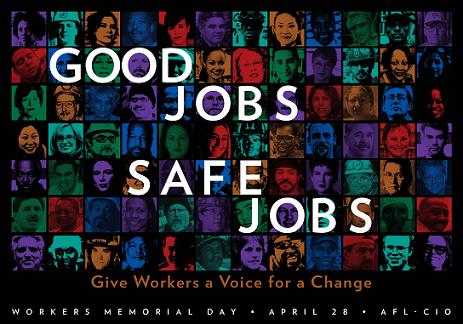
On April 28, we observe Workers Memorial Day to remember those who have suffered and died on the job and to renew the fight for safe workplaces.
In 2009, we must fight for:
- Full OSHA coverage for all workers. More than 8.8 million state and local public employees, flight attendants and other worker have no protection under the OSHA law.
- Stronger criminal and civil penalties for violations. The average penalty for a serious violation of the OSHA law is woefully low, only $960. The median penalty in enforcement cases involving a worker’s death was only $3,675. Criminal penalties under the OSHA law are weaker than all other safety and health laws.
- New workplace safety and health standards. In 38 years, OSHA has set standards for only 29 toxic substances; for many hazards standards are out of date or non-existent. There is a huge backlog of standards that need to be issued including rules on silica, beryllium, cranes and derricks, diacetyl and combustible dust.
- Protections against ergonomic hazards. Musculoskeletal disorders like back injuries and carpal tunnel syndrome remain the biggest job safety problem, responsible for 30 percent of all workplace injuries and costing billions of dollars each year.
- Complete and accurate reporting of workplace injuries and illnesses. Even though the toll of workplace injuries is high, recent studies have found that those reports may miss as many as two out of three workplace injuries. Increasingly workers are being discouraged from reporting job injuries, often facing discipline or termination when they are injured.
- Improved mine safety protections. In 2006, as a result of the Sago mine disaster and other accidents, Congress enacted the Mine Improvement and New Emergency Response Act to require stricter standards on mine rescue, communications and oxygen availability and set penalties for egregious and repeated violations.
- Worker protections for pandemic flu. In the event of a pandemic flu outbreak, millions of healthcare workers and other responders will be on the front lines and at increased risk of infection, disease and death. Current guidelines are inadequate and many healthcare facilities have taken no action to prepare for a flu pandemic.

|
|
 Related Articles


